
ADM Jabalpur v. Shivkant Shukla (1976): The Emergency, the Majority’s Silence, and the Dissent That Endured
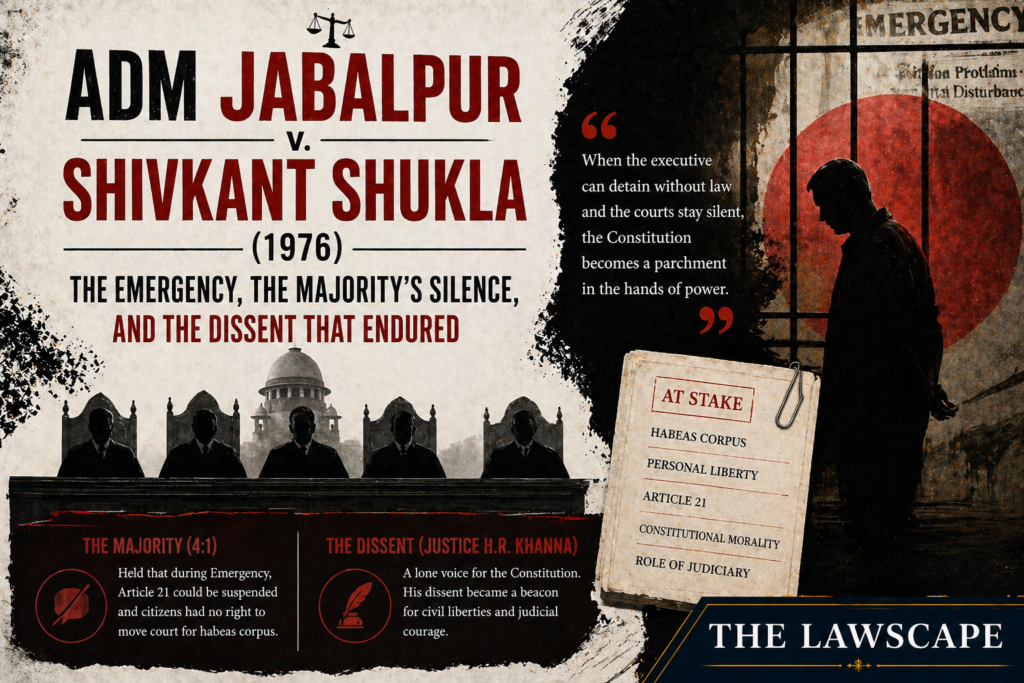
Author: Shubham Upadhyay
Student, Faculty of Legal Sciences, Shoolini University, Solan
Co-Author: Mrs. Richika Mehta
Assistant Professor (IPR), Faculty of Legal Sciences, Shoolini University
——————————————————————————————
💡 3 Quick Takeaways
1. By a 4:1 majority, the Supreme Court held that during the 1975 Emergency, no person detained under MISA could approach a High Court for the writ of habeas corpus — effectively placing executive detention beyond all judicial scrutiny for the duration of the Emergency.
2. Justice H.R. Khanna’s lone dissent — that the right to life cannot be suspended even by a Presidential Order, and that the Courts retain the power to examine whether detention complies with the law — was overruled in 1976 but later vindicated by the 44th Constitutional Amendment and by Puttaswamy (2017).
3. Justice P.N. Bhagwati subsequently made a public admission that his concurrence with the majority was wrong — one of the most candid judicial self-corrections in Indian legal history, and a measure of how profoundly the judgment was regarded as a constitutional failure.
Case Title: Additional District Magistrate, Jabalpur v. Shivkant Shukla
Citation: (1976) 2 SCC 521; AIR 1976 SC 1207
Court: Supreme Court of India — Five-Judge Constitution Bench
Bench: Chief Justice A.N. Ray, Justice M.H. Beg, Justice Y.V. Chandrachud, Justice P.N. Bhagwati, and Justice H.R. Khanna
Date of Judgment: 28 April 1976
Introduction
ADM Jabalpur v. Shivkant Shukla — widely known as the Habeas Corpus case — arose from the Emergency proclaimed by President Fakhruddin Ali Ahmed on 25 June 1975. At its heart was a question that no constitutional democracy should ever have to answer: can the State imprison its citizens, without trial, without charge, and without any possibility of judicial recourse? By a majority of four to one, the Supreme Court answered in the affirmative. The High Courts that had granted relief to detainees were overruled. The fundamental right to life and personal liberty, guaranteed under Article 21, was held to be unenforceable during the Emergency by reason of the Presidential Order under Article 359.
The decision was delivered by a five-judge Constitution Bench headed by Chief Justice A.N. Ray on 28 April 1976. Four judges — Chief Justice Ray, Justice M.H. Beg, Justice Y.V. Chandrachud, and Justice P.N. Bhagwati — formed the majority. Justice H.R. Khanna dissented alone. The writ of habeas corpus — whose very name, meaning “you shall have the body,” embodies the most basic protection against unlawful detention — was held unavailable to thousands of people imprisoned across the country. It is remembered as one of the gravest judicial failures in independent India.
Facts and Background
The immediate political context began with the general election of 1971. Following that election, Raj Narain — the socialist politician who had opposed Indira Gandhi in her Rae Bareli constituency — challenged the validity of her election on grounds of corrupt practice. On 12 June 1975, Justice Jagmohanlal Sinha of the Allahabad High Court found her guilty of electoral malpractice and set aside her election. Gandhi approached the Supreme Court seeking a conditional stay, which was granted subject to restrictions on her participation in parliamentary proceedings.
Rather than resign, Gandhi advised President Fakhruddin Ali Ahmed to proclaim a national Emergency under Article 352(1) of the Constitution, citing internal disturbance as the ground. The proclamation was issued on 25 June 1975. The Emergency brought sweeping consequences — the freedoms under Article 19 stood suspended under Article 358, and a Presidential Order under Article 359 suspended the right of citizens to move any court for enforcement of their fundamental rights under Articles 14 and 21.
Under the Maintenance of Internal Security Act, 1971 (MISA), the government began detaining political opponents, journalists, activists, and civil society figures without trial. Prominent leaders including Atal Bihari Vajpayee, Jayaprakash Narayan, Morarji Desai, and L.K. Advani were among those detained. Habeas corpus petitions were filed before High Courts across the country. Several High Courts — including those of Allahabad, Bombay, Karnataka, Madhya Pradesh, and Rajasthan — granted relief to detainees, holding that courts retained the power to examine whether detention orders complied with MISA’s own requirements even during the Emergency.
The Government of India appealed against these decisions. The matters were consolidated and placed before a five-judge Constitution Bench of the Supreme Court, resulting in the judgment that came to be known as the Habeas Corpus case.
Issues Raised
- Whether a citizen, following the Presidential Order under Article 359(1) suspending the right to move courts for enforcement of fundamental rights, could seek a writ of habeas corpus before a High Court challenging the legality of detention under MISA.
- Whether the suspension of Article 21 during the Emergency was consistent with the rule of law.
- Whether a detainee retained any locus standi — the legal right to approach a court — during the Emergency period.
The State’s Legal Position
The State’s argument was that the constitutional Emergency provisions — Articles 358, 359(1), and 359(1A) — conferred on the Executive the power to act without the usual constitutional constraints, and that whatever the State found valid during the Emergency was to be treated as valid. The submission of writ petitions under Article 226 was suspended, and petitioners could not seek court intervention to enforce rights whose enforcement had been suspended by the Presidential Order. The State accordingly maintained that detainees had no locus standi to approach any court, and that the writ of habeas corpus was simply not available for the duration of the Emergency.
Judgment
The Supreme Court held, by a majority of four to one, that no person could under Article 226 seek a writ of habeas corpus or any other writ or direction in a High Court challenging the lawfulness of a detention order on any ground, including non-compliance with MISA, mala fides, or illegality. Section 16A(9) of MISA was upheld as constitutionally valid. The decisions of the various High Courts that had granted relief to detainees were set aside.
The majority — Chief Justice Ray, Justice Beg, Justice Chandrachud, and Justice Bhagwati — reasoned that the Presidential Order under Article 359 had effectively removed the jurisdiction of courts to examine any question concerning the enforcement of suspended fundamental rights during the Emergency. In M.M. Damnoo v. State of Jammu and Kashmir (1972), the Court had previously held that the State was obliged to provide the grounds of detention so that courts could verify whether the basis for arrest was connected to state security. That protective approach was now set aside.
Justice H.R. Khanna alone dissented. He argued that the right to life and personal liberty is not a creature of the Constitution — it pre-exists the Constitution as a basic human right. Suspending Article 21 does not extinguish the right itself. More fundamentally, the suspension of the right to move courts for enforcement of fundamental rights under Article 359 is not the same as suspending the courts’ power to examine whether the executive has acted within the law. Courts could still enquire — and should still enquire — whether a detention order complied with MISA’s own statutory requirements, even if specific enforcement of Article 21 was restricted. Justice Khanna also relied on Makhan Singh v. State of Punjab (1964), which held that a detainee may challenge a detention order on grounds other than fundamental rights — grounds not covered by a Presidential suspension under Article 359.
Justice Khanna’s dissent came at personal cost. Despite being the most senior judge after the Chief Justice, he was superseded — Justice Beg, who had formed part of the majority, was appointed Chief Justice of India in his place.
Analysis
The majority’s reasoning rested on a formalistic reading of Article 359 that produced results deeply at odds with constitutional principle. Article 21 guarantees that no person shall be deprived of life or personal liberty except according to procedure established by law. The majority held that the suspension of the right to enforce this guarantee effectively meant that executive detention was beyond all judicial scrutiny for the duration of the Emergency. As critics and later judges have observed, this reasoning conflated the suspension of a remedy with the elimination of all legal constraints on executive action.
There is a significant conceptual distinction between Article 358 and Article 359. Article 358 suspends the fundamental rights under Article 19 during an Emergency. Article 359 does not suspend fundamental rights themselves — it suspends the right of citizens to move courts for their enforcement. The majority treated this distinction as irrelevant. Justice Khanna maintained that it was decisive.
The Emergency was widely perceived as a mechanism to protect one person’s political position rather than to address any genuine threat to national security. The arrest and detention without trial of opposition leaders, journalists, and civil society figures on a mass scale left little doubt about the political motivations driving the use of MISA. The Supreme Court’s majority, in endorsing the suspension of judicial review, lent constitutional legitimacy to what many regarded as an exercise of raw political power.
The consequences were stark. When Justice Khanna — sitting in court — asked the Attorney General whether the government’s position meant that even unlawful killing by the State could not be challenged before a court during the Emergency, the answer offered was in the affirmative. That exchange has since become emblematic of how far the majority’s reasoning extended in its implications.
Justice P.N. Bhagwati, who had formed part of the majority, later made a public admission that his concurrence had been wrong. In a statement that reflected the gravity of the constitutional failure, he said that he would have agreed with Justice Khanna if given the opportunity to reconsider and that his decision to go with the majority was a sign of weakness on his part. Former Chief Justice M.N. Venkatachaliah similarly observed, in a Khanna Memorial Lecture in 2009, that the majority ruling in the Emergency case must be consigned to the oblivion of history.
Aftermath of the Judgment
The Emergency was revoked in 1977 after the Congress party was voted out of power. The immediate judicial correction came in Maneka Gandhi v. Union of India (1978), in which a seven-judge bench of the Supreme Court — in the context of a passport impoundment challenge — overruled A.K. Gopalan v. State of Madras (1950) and established the interconnection of Articles 14, 19, and 21 as a unified framework for the protection of personal liberty. The Court affirmed that procedure established by law must itself be fair, just, and reasonable — a substantive standard that directly repudiated the formalism of the ADM Jabalpur majority.
The 44th Constitutional Amendment, enacted in 1978, introduced further structural safeguards. Articles 20 and 21 were made non-suspendable — they cannot be suspended even during a proclaimed Emergency, closing the very gap that the majority had exploited. The ground of “internal disturbance” under Article 352 was replaced with “armed rebellion,” raising the threshold for proclamation to prevent the Emergency power from being misused for political ends. The combined effect of the 44th Amendment and subsequent judicial interpretation was to comprehensively repudiate the constitutional framework on which the ADM Jabalpur majority had rested.
In Justice K.S. Puttaswamy v. Union of India (2017), a nine-judge Constitution Bench of the Supreme Court expressly and unanimously overruled ADM Jabalpur, confirming that the right to life and personal liberty under Article 21 is inalienable and cannot be suspended by Presidential Order.
Conclusion
ADM Jabalpur v. Shivkant Shukla is remembered not for what the majority decided, but for what one judge refused to decide — and for the price he paid for that refusal. The majority’s formal reasoning, though internally consistent on its own terms, produced an outcome that placed the executive power to detain beyond all legal accountability for the duration of the Emergency. It was, as later judges and the Constitution itself acknowledged, a fundamental error.
Justice Khanna’s dissent — grounded in the inalienable nature of the right to life and in the rule of law’s requirement that all executive action must be capable of judicial scrutiny — was the correct constitutional answer in 1976. It became the law of the land in 2017. The 44th Amendment and Maneka Gandhi had already gone a long way toward correcting the damage. Puttaswamy completed that correction explicitly.
The case remains a defining study in constitutional history — in judicial courage, in institutional failure, and in the law’s capacity to eventually correct its most serious mistakes. As Justice Khanna demonstrated, the rule of law does not disappear because the majority says it does. And as the subsequent history of the judgment shows, neither does the truth.
Disclaimer: The views expressed in this article are those of the author and do not necessarily reflect the views of The Lawscape.
The Lawscape — clear, practical legal insight for students and future lawyers.