
Maneka Gandhi v. Union of India (1978): From Procedural Safeguard to Substantive Due Process
Author: Elizabeth Liu
Co-Author: Neville Gonsalves
Students, Lords Universal College of Law
——————————————————————————————
💡 3 Quick Takeaways
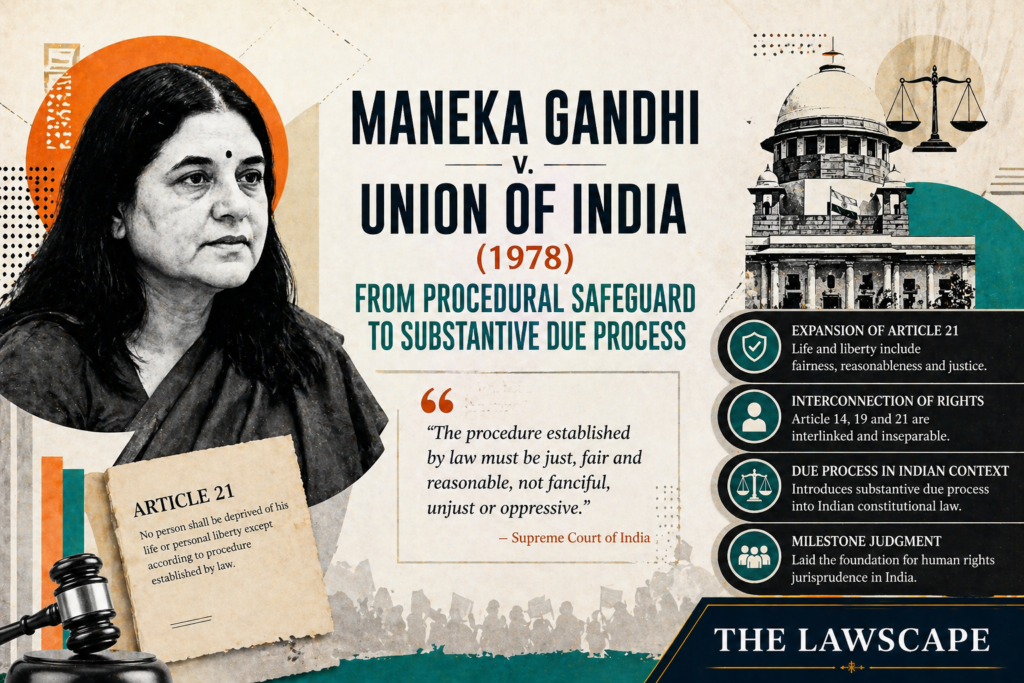
1. Maneka Gandhi v. Union of India transformed Article 21 from a narrow procedural guarantee into a substantive protection of human dignity — holding that any procedure depriving a person of life or liberty must be fair, just, and reasonable, not merely legally prescribed.
2. The judgment established the “golden triangle” — the interlocking relationship between Articles 14, 19, and 21 — overruling A.K. Gopalan‘s treatment of these Articles as separate, watertight compartments and placing all executive action under the scrutiny of the entire Part III framework.
3. The principle of audi alteram partem was held to be flexible — ideally prior to a decision but capable of being applied post-decision where urgency, such as the risk of flight, makes pre-hearing impractical — establishing a pragmatic standard for natural justice in administrative law.
Case Title: Maneka Gandhi v. Union of India
Citation: AIR 1978 SC 597; (1978) 1 SCC 248
Court: Supreme Court of India — Seven-Judge Bench
Bench: Chief Justice M. Hameedullah Beg, Justice N.L. Untwalia, Justice P.N. Bhagwati, Justice P.S. Kailasam, Justice S. Murtaza Fazal Ali, Justice V.R. Krishna Iyer, and Justice Y.V. Chandrachud
Date of Judgment: 25 January 1978
Parties:
- Appellant/Petitioner: Maneka Gandhi
- Respondent: Union of India
Introduction
Maneka Gandhi v. Union of India is a landmark case in Indian constitutional law that fundamentally changed how Article 21 was understood — transforming it from a simple procedural safeguard into a substantive guarantee of human dignity linked to equality under Article 14 and the freedoms protected by Article 19. The decision came in the immediate aftermath of the Emergency, at a moment when public concern about executive overreach was at its height, and was delivered by a seven-judge bench led by Chief Justice M. Hameedullah Beg. Justices P.N. Bhagwati and V.R. Krishna Iyer contributed particularly significant concurring opinions that shaped the doctrinal framework the case is now known for.
The immediate trigger was the arbitrary impoundment of the petitioner’s passport under the Passports Act, 1967. But the constitutional questions the case raised went far beyond passport law. The bench was called upon to determine the nature and scope of personal liberty, the relationship between Articles 14, 19, and 21, and the extent to which principles of natural justice — particularly the right to be heard — apply to executive administrative action affecting fundamental rights.
Facts of the Case
Maneka Gandhi, a journalist, held a valid passport issued on 1 June 1976, which was valid until 1981. She had arranged a BBC interview in London scheduled for 11 July 1977. On 7 July 1977, while at Delhi’s Palam airport for check-in, she was stopped and handed a telegram from the Regional Passport Officer ordering that her passport be impounded under Section 10(3)(c) of the Passports Act, 1967, on grounds of “the interests of the general public.” The order was issued without any prior notice, without reasons, and without an opportunity to be heard.
She immediately surrendered her passport and on 9 July wrote to the Regional Passport Officer seeking the reasons for the action. The reply, received on 14 July, invoked Section 10(5) of the Act — which provides for non-disclosure of reasons — stating that disclosure was not in the public interest. Only vague internal reasons were offered.
On 11 August 1977, she filed Writ Petition No. 231 of 1977 before the Supreme Court under Article 32, alleging violations of Articles 14, 19(1)(a) and (g), and 21 of the Constitution. The Court declined to grant an interim stay on the restriction against foreign travel. Following the filing, on 22 August the government proposed a personal hearing and offered reasons vaguely connected to foreign policy considerations. The petitioner rejected this proposal on 26 August and insisted on the order being set aside altogether. There were no criminal charges against her, and no credible evidence of flight risk. The context of the case — the political dynamics following the Emergency and the change of government — lent the proceedings a significance that went well beyond the facts of any individual passport dispute.
The legal landscape the case exposed was significant. The Passports Act, 1967 — enacted following the Supreme Court’s decision in Satwant Singh Sawhney v. Union of India (1967) — set out the grounds on which passports could be impounded under Section 10(3) and required internal recording of reasons under Section 10(5), but it contained no requirement to afford the passport holder a hearing before the order was passed. This procedural gap formed the constitutional crux of the case.
Issues Raised
- Whether the impoundment of the passport without a prior hearing violated Article 21, which requires that any deprivation of life or personal liberty be subject to a procedure that is fair, reasonable, and non-arbitrary, and whether that requirement is informed by Articles 14 and 19.
- Whether the principle of audi alteram partem — the right to be heard — extends to administrative actions that affect personal liberty, and whether a post-decisional hearing would be sufficient to cure the procedural deficiency.
Arguments of the Parties
Appellant (Maneka Gandhi)
Counsel for the petitioner began with the broad scope of personal liberty under Article 21, drawing on Satwant Singh Sawhney v. Union of India (1967), in which the Supreme Court had struck down the refusal of a passport without any governing law as violative of the right to travel abroad. They argued that the impoundment of Maneka Gandhi’s passport under Section 10(3)(c) had similarly restricted personal liberty without a procedure established by law that met constitutional standards, thereby violating Article 21. Reliance was also placed on Kharak Singh v. State of Uttar Pradesh (1963), in which the Court had recognised that Article 21 extends beyond freedom from physical detention to cover other aspects of personal liberty — including freedom of movement.
On natural justice, the petitioner invoked audi alteram partem as an implied requirement of the procedure under Article 21, arguing that A.K. Gopalan v. State of Madras (1950) — which had treated Articles 19 and 21 as entirely separate — had been superseded by R.C. Cooper v. Union of India (1970) and Haradhan Saha v. State of West Bengal (1974), which recognised that the reasonableness standard under Article 19 applies even to restrictions on personal liberty. The absence of any guidelines in Section 10(3)(c) for the exercise of the “general public interest” ground was attacked as conferring arbitrary discretion — similar in nature to the vague classification struck down under Article 14 in State of West Bengal v. Anwar Ali Sarkar (1952). The non-disclosure provision in Section 10(5), which prevented the petitioner from knowing why her passport was seized, was argued to have eliminated any meaningful remedy. Associated Cement Co. Ltd. v. P.N. Sharma (1965) was cited for the proposition that audi alteram partem extends to administrative actions having civil consequences.
The strategic thrust of the petitioner’s case was that the Passports Act had created a constitutional vacuum — internal recording of reasons was insufficient, and disclosure and a prior hearing were constitutional necessities. The post-decision offer of a hearing was dismissed as an inadequate cure. In seeking an order quashing the impoundment, the petitioner’s argument drew support from international and comparative due process jurisprudence, including the balancing approach in Mathews v. Eldridge (US), and successfully humanised the constitutional claim by grounding it in the lived experience of an individual facing arbitrary state action.
Respondent (Union of India)
The Attorney General, S.V. Gupte, assisted by Soli Sorabjee, characterised the impoundment as a purely administrative act under the Passports Act, 1967 — a law enacted specifically to provide a statutory basis for passport regulation following Satwant Singh. Since the power was administrative in nature and not quasi-judicial, there was no requirement for a pre-decision hearing. Reliance was placed on A.K. Gopalan for the position that procedure established by law means what the statute provides — courts cannot import additional procedural requirements from outside the legislation.
Section 10(3) was defended as sufficiently guided — it set out specific grounds for impoundment, of which “general public interest” under Section 10(3)(c) was a residual but informed category. The respondent distinguished Anwar Ali Sarkar, arguing that no impermissible classification was involved. On the urgency point, it was argued that Maneka Gandhi had been checked in for a London-bound flight at the time the order was served, creating a practical risk that made prior notice impracticable. The post-decision hearing offered on 22 August was presented as fully adequate, relying on Ridge v. Baldwin [1964] as authority for the proposition that a post-decision hearing can suffice in cases of urgency.
More broadly, the respondent argued for judicial restraint — mandating pre-decision hearings across administrative action would paralyse government, particularly in security-sensitive cases. The non-disclosure provision in Section 10(5) was defended as striking an appropriate balance between transparency and the requirements of national security. The Article 14 and 19 interlinkage was resisted on the basis of Gopalan, with the respondent maintaining that Article 21 stands independently and that the right to travel abroad is not absolute.
Judgment
The seven-judge bench decided unanimously in its outcome — the petition was dismissed but the government was directed to provide reasons and afford a hearing to the petitioner — though the judges delivered multiple concurring opinions reflecting different analytical approaches.
Chief Justice Beg grounded personal liberty in natural law, tracing the historical development of Article 21 through Satwant Singh and Kharak Singh and rejecting Gopalan‘s compartmentalisation of fundamental rights. Justice Bhagwati constructed the conceptual framework that has since come to define the case — the “golden triangle” — holding that any procedure under Article 21 must be fair, just, and reasonable, and that this standard is informed by the non-arbitrariness requirement of Article 14 and the reasonableness standard of Article 19. Justice Krishna Iyer’s concurring opinion emphasised the dignity dimension of Article 21, linking personal liberty to the fuller development of human personality.
Section 10(3)(c) of the Passports Act was upheld as constitutionally valid — it was found to be sufficiently guided by the grounds specified in the provision and not vague in the manner condemned in Anwar Ali Sarkar. The impoundment order was not found to be made in bad faith, and judicial review was confirmed as available notwithstanding the non-disclosure provision in Section 10(5). On natural justice, the Court held that audi alteram partem is an implied requirement of the procedure under Article 21, but that it is flexible in its application — a pre-decision hearing is the constitutional ideal, but a post-decision hearing may suffice where urgency, such as a flight risk, makes prior notice impracticable. The government was directed to provide reasons and conduct a hearing, thereby affording the petitioner a remedy without invalidating the Act or the order.
Ratio Decidendi
The ratio decidendi of Maneka Gandhi operates at several levels.
On Article 21, the Court held that “procedure established by law” is not satisfied by any procedure a legislature chooses to enact — the procedure must itself be fair, just, and reasonable. This marked a decisive shift from the positivist reading in Gopalan, which had held that any procedure enacted by law was sufficient. Article 21 now imposes a substantive standard, not merely a formal one.
On the golden triangle, the Court held that Articles 14, 19, and 21 are not separate and self-contained — they are interconnected. A law or executive action that deprives a person of personal liberty must satisfy the non-arbitrariness test of Article 14 and the reasonableness test of Article 19, in addition to meeting the procedural requirements of Article 21. No action affecting life or liberty escapes the scrutiny of the full Part III framework.
On natural justice, the Court held that audi alteram partem is a necessary ingredient of the procedure required by Article 21. However, the principle is flexible — it does not always require a pre-decision hearing. Where urgency makes this impracticable, a curative post-decision hearing may suffice, provided it is genuine and not merely a formal exercise.
On Section 10(3)(c), the Court confirmed that the “general public interest” ground is not unconstitutionally vague — it is informed and guided by the other grounds listed in Section 10(3) and is judicially reviewable. The non-disclosure provision in Section 10(5) does not grant absolute immunity from judicial scrutiny.
The ratio’s enduring significance lies in its transformation of “procedure established by law” into a substantive due process standard — achieved through constitutional interpretation without any formal amendment — and in the operationalisation of the golden triangle as a unified framework for testing the validity of all State action affecting fundamental rights. The judgment laid the doctrinal foundation for subsequent decisions on privacy (Justice K.S. Puttaswamy v. Union of India, 2017), livelihoods (Olga Tellis v. Bombay Municipal Corporation, 1985), and the full scope of Article 21 jurisprudence.
Conclusion
Maneka Gandhi v. Union of India consummated a constitutional transformation. By overruling A.K. Gopalan‘s procedural negativity and establishing the golden triangle of Articles 14, 19, and 21, the seven-judge bench ensured that any deprivation of life or liberty must be subjected to procedures that are fair, just, and reasonable — permeated with natural justice. The “public interest” ground in Section 10(3)(c) was upheld as valid, and audi alteram partem was confirmed as flexible: ideally prior to the decision, but curative after where urgency demands, thereby balancing administrative efficiency with individual fairness.
The judgment’s legacy extends far beyond passport law. It established judicial review as a permanent sentinel against executive caprice, gave constitutional grounding to natural justice in administrative law, and set in motion a body of jurisprudence on livelihood, privacy, and dignity that continues to develop. Celebrated as a corrective to the constitutional failures of the Emergency era and a direct response to the shadow of ADM Jabalpur, Maneka Gandhi enshrined “procedure established by law” not as a technical formula but as a moral commitment — ensuring that “public interest” can never be used as a mask for arbitrary state power.
Disclaimer: The views expressed in this article are those of the author and do not necessarily reflect the views of The Lawscape.
The Lawscape — clear, practical legal insight for students and future lawyers.